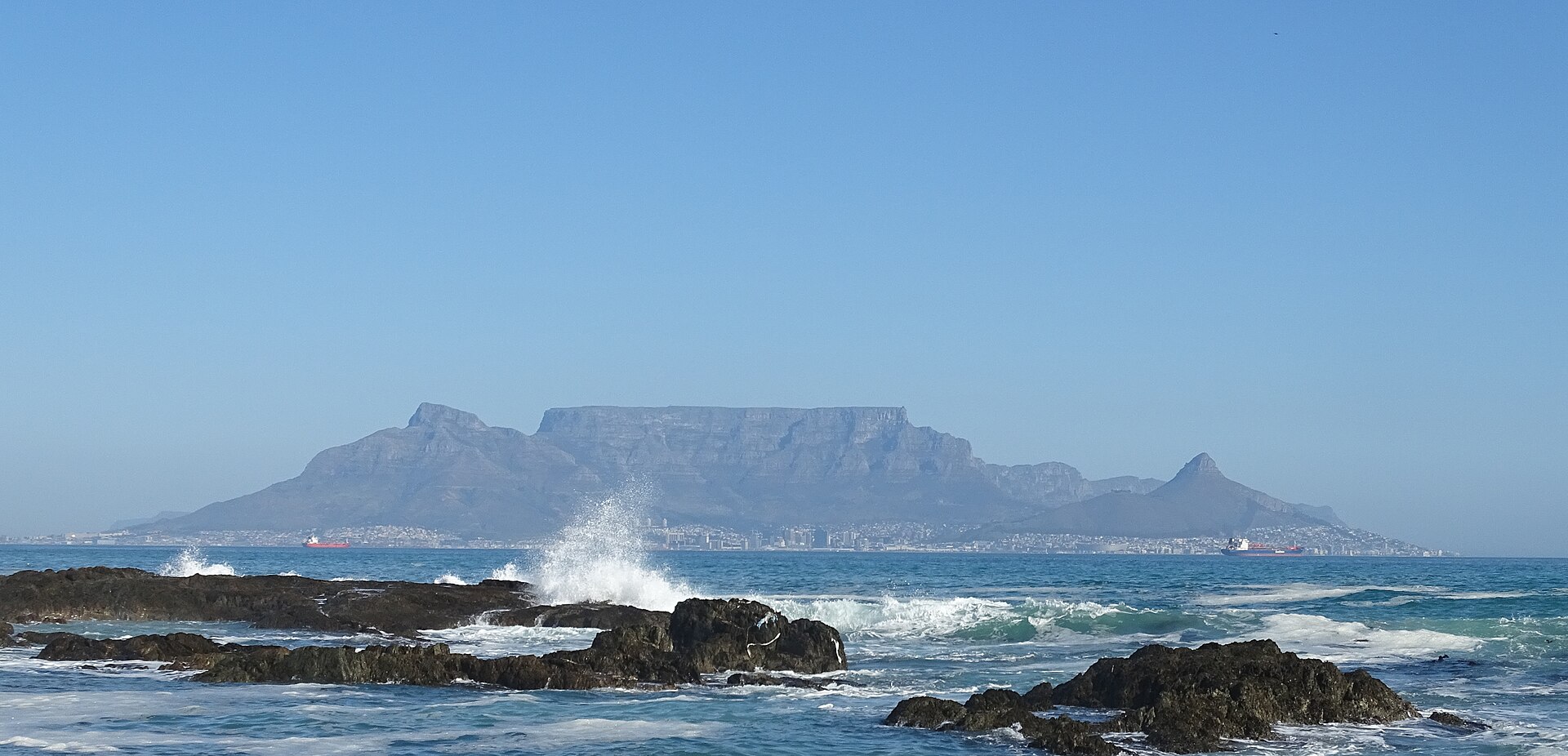
There is a moment on Bloubergstrand, maybe twenty minutes after the sun has gone, when most people have already shaken the sand off and left. The sky over the Atlantic is still working through its last register of colour, deep orange into rose into a blue that has no proper name, and Table Mountain across the bay has flattened into pure silhouette. The people still on the beach at that point are almost all holding cameras. They know something the early leavers do not: at Blouberg, the sunset is not an event with a single time. It is a forty-minute performance, and the advertised time is only the interval.
This guide gives you the actual times, month by month, plus the honest answer to a harder question: which evenings are worth the trip. Because Cape Town does not produce a postcard every night, and the difference between a flat grey fade and a sky on fire comes down to cloud, wind and air, all of which follow a pattern you can learn.
What time the sun sets, month by month
Bloubergstrand keeps Cape Town’s clock, SAST all year with no daylight saving, so sunset moves only with the seasons. The swing is large: just after 20:00 in early January, down to 17:45 by mid-June. The table below gives the sunset time on the 21st of each month; add or subtract a minute or two for other dates.
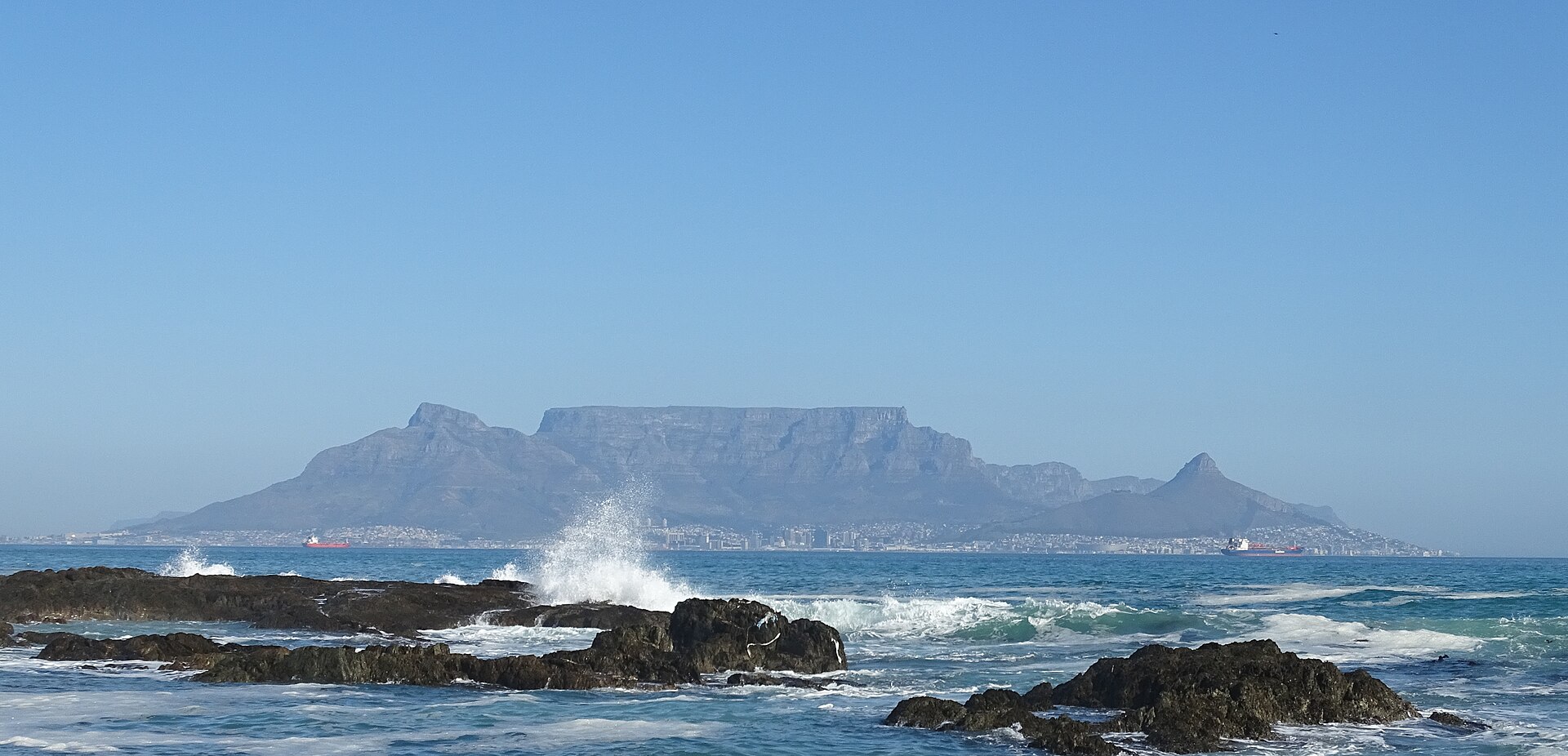

You are free to use this picture for any purpose as long as you credit its author, Ad Meskens.
Example: © Ad Meskens / Wikimedia Commons
If you use this work outside of the Wikimedia projects, a message or a copy is very much appreciated.
This image is not in the public domain. A statement such as "From Wikimedia Commons" or similar is not by itself sufficient. If you do not provide clear attribution to the author you do not comply with the terms of the file’s license and you may not use this file. If you are unable or unwilling to provide attribution you should contact Ad Meskens to negotiate a different license., via Wikimedia Commons (taken on location) — CC BY-SA 4.0
| Month (21st) | Sunset | Month (21st) | Sunset |
|---|---|---|---|
| January | 19:58 | July | 17:59 |
| February | 19:32 | August | 18:21 |
| March | 18:57 | September | 18:43 |
| April | 18:16 | October | 19:05 |
| May | 17:50 | November | 19:33 |
| June | 17:45 | December | 19:57 |
The extremes: the latest sunsets of the year land in the first week of January at just after 20:00, and the earliest arrive around mid-June at 17:45. This week, mid-April, the sun goes down at roughly 18:20.
Two timing rules matter more than the headline number. First, golden hour: the low, warm light photographers chase starts about 45 minutes before sunset, so arrive early. Second, afterglow: the strongest colour often comes 15 to 25 minutes after the sun has dropped, when high cloud catches red light from below the horizon. If you pack up at the moment of sunset you will regularly miss the best sky of the evening on the drive home.
One quirk of the geography rewards attention through the year. The sun always sets over the sea here, but its position slides along the horizon: far to the south-west in midsummer, well to the north-west in midwinter. Around the equinoxes, late March and again in late September, it drops close to the low line of Robben Island, which sits almost due west of the beach.
The recipe for a proper sunset
A cloudless evening at Blouberg is pleasant and brief. The sun touches the water, the sky runs through yellow and a modest orange, and it is over. The spectacular evenings need ingredients, and atmospheric scientists have actually written them down.
The first is high cloud. Thin cirrus and mid-level cloud sit high enough to stay in direct sunlight for many minutes after the sun has left the beach, and they catch that reddened light on their undersides. Forecasters who study twilight colour suggest partial cover, very roughly half the sky, as the sweet spot: enough cloud to hold the light, enough gap on the western horizon for the light to get through. A solid grey bank sitting on the sea kills the show before it starts.
The second is clean air. This is counter-intuitive, but haze and dust mute sunset colour rather than enhance it; the most vivid reds and oranges come through air that has been scrubbed. That is why the evenings after a winter cold front, once the rain has passed and the sky is breaking up into torn cloud, can be the best of the whole year, even if you watch them from a car with the heater on.
The third is wind, and here Blouberg has a split personality. From roughly October to March the southeaster, the Cape Doctor, hammers this coast on many afternoons. It makes for its own kind of picture: spray tearing off the whitecaps, dozens of kiters silhouetted against the colour, the scene that fills the beach at Big Bay on a foiling day. But it is hostile to tripods, long lenses and picnic blankets. In autumn the pattern breaks. The southeaster loses its grip, the sea settles, and the air over the bay goes still and glassy.
Where to stand
The whole shoreline from Milnerton to Melkbosstrand faces the sunset, so you cannot really get it wrong. But a few spots earn their reputations.
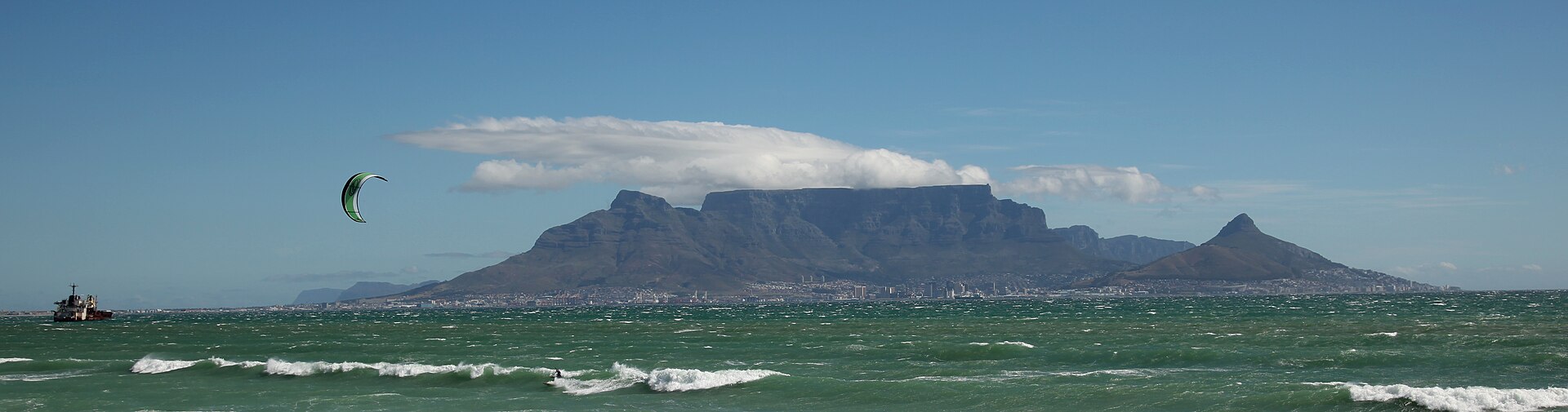

The rocks at Bloubergstrand village. The classic. Small Bay and Big Bay are separated by a rocky point, and the boulders scattered along this stretch give the foreground interest that turns a nice view into the photograph everyone recognises: wet rock, white water, Table Mountain across the bay. There is a parking area on Stadler Road near Ons Huisie, the old fisherman’s cottage that is now a restaurant and a national monument, and from there you are on the sand in under a minute. This may be the most photographed vantage of Table Mountain there is, and at golden hour you will share it; walk two hundred metres either way and you will not.
The promenade at Table View. Best for an unfussy evening: benches, a flat paved edge to the beach, coffee nearby. The full route is covered in our promenade walking guide, and an out-and-back timed to end at sunset is about as good as an ordinary weekday gets.
Big Bay. The wide arc of sand gives you the biggest sky in the area, and on windy evenings the kiters supply the foreground. The grassy banks above the beach at Eden on the Bay let you watch the whole thing with a takeaway in hand.
Eerste Steen. A few kilometres north along Otto du Plessis Drive, this City-run picnic and braai site inside the Blaauwberg Nature Reserve is the locals’ choice for a sundowner braai, with the beach right below. One serious caveat for planners: as of April 2026 the gates close at 19:00 in summer (November to April) and at 17:00 through winter (May to October). Both closings beat the sun for much of the year: winter’s 17:00 is well before dusk, and in high summer the sun itself sets after 19:00. The braai-at-dusk plan really only works when sunset slips back before the gates shut, roughly mid-March into April. This month, in other words. Check ahead. Families rate it for space to run around; we covered it in Blouberg with kids.
Full moons worth planning for
On full-moon evenings the show runs in both directions. The moon rises opposite the setting sun, which at Blouberg means it comes up over the land to the east while the colour builds over the sea behind you. It does not rise behind Table Mountain from this side of the bay, whatever the composite images suggest; the mountain lies to the south, the moonrise to the east, and no lens can fold the two together honestly from this beach.
What the geometry does give you is a two-act evening: sunset over the Atlantic, then turn around for a fat orange moon climbing over the distant hills. Photographers often favour the evening before the exact full moon, when the moon rises shortly before sunset and there is still enough daylight to balance the exposure, rather than a brilliant disc in a black sky.
The remaining full moons of 2026, on South African time, fall on:
- Friday 1 May
- Sunday 31 May (a second May full moon, a blue moon)
- Tuesday 30 June
- Wednesday 29 July
- Friday 28 August
- Saturday 26 September
- Monday 26 October
- Tuesday 24 November
- Thursday 24 December
Several of these reach exact full in the small hours, so the moon looks essentially full on both flanking evenings; treat the dates as the centre of a two-night window. April’s full moon has already been and gone this year, on the 2nd.
There is also a quieter prize at the other end of the day. Around full moon, the moon sets over the sea at roughly the time the sun rises, so an early walk on the beach can catch it dropping into the Atlantic while the first light works down the face of Table Mountain. Almost nobody is out there for it.
Why April is the month the photographers circle
Ask the people who shoot this coastline seriously and a pattern emerges: autumn, and April in particular, is when Blouberg does its best work. The reasons line up neatly with the recipe above. The summer wind has faded, so the air is still and the sea holds reflections instead of chop. The first weak fronts start pushing bands of high cloud across the Cape, exactly the kind that light up after sundown, without yet bringing the full grey blankets of winter. And the sun now sets at a civilised 18:15 or so, early enough to catch on a weekday and still be home for supper.
The water, for what it is worth, is still at its least punishing after a summer of warming, though “least punishing” is doing heavy lifting on this coast; see our honest answer on swimming at Bloubergstrand before you plan a sunset dip.
So this month, pick an evening when the forecast shows broken high cloud and light wind, be on the sand by 17:30, and stay until the colour has completely drained, somewhere past 18:45. On the first of May, stay a little longer and turn east.
Sources & further reading
- Gaisma: Cape Town sunrise, sunset, dawn and dusk times for the whole year
- timeanddate.com: Sunrise and sunset times in Cape Town
- Stephen F. Corfidi (NOAA Storm Prediction Center): The Colors of Sunset and Twilight
- Astronomy.com: 2026 Full Moon calendar, dates and times
- Western Cape Government: Eerste Steen Braai Area
- Cape Town Tourism: Bloubergstrand neighbourhood guide
- SA-Venues: Ons Huisie, Bloubergstrand
- Royal Museums Greenwich: Full Moon calendar 2026
Featured image: Cape Town Table Mountain 10.jpg by Ad Meskens
You are free to use this picture for any purpose as long as you credit its author, Ad Meskens.
Example: © Ad Meskens / Wikimedia Commons
If you use this work outside of the Wikimedia projects, a message or a copy is very much appreciated.
This image is not in the public domain. A statement such as "From Wikimedia Commons" or similar is not by itself sufficient. If you do not provide clear attribution to the author you do not comply with the terms of the file’s license and you may not use this file. If you are unable or unwilling to provide attribution you should contact Ad Meskens to negotiate a different license., via Wikimedia Commons (taken on location) — CC BY-SA 4.0