Cape Town’s City Bowl is the flat, historic basin cupped between Table Mountain, Signal Hill and the harbour, and it holds most of the city’s best walkable sightseeing in one compact grid. In a single day on foot you can cover Bo-Kaap’s coloured houses, the oak-lined paths of Company’s Garden, the bars of Long Street and the ramparts of the Castle of Good Hope, all within about a 2km stretch.
What is Cape Town’s City Bowl?
The City Bowl is the name locals use for Cape Town’s central business district and the residential slopes around it, including Bo-Kaap, Gardens, Tamboerskloof and Vredehoek. It’s named for its shape: a natural amphitheatre with Table Mountain and Devil’s Peak behind it and Table Bay in front.
Because it’s compact and mostly flat at street level, the City Bowl rewards walking over driving. Most of the sights below sit within 15 to 20 minutes of each other on foot, with Adderley Street and Long Street as the two main spines to orient yourself by.
Bo-Kaap: the streets everyone photographs
Bo-Kaap is the pastel-painted neighbourhood on the lower slopes of Signal Hill, about a five-minute walk from the top of Wale Street in the CBD. Its best-known stretch, Rose Street, is where most of the postcard photos come from, but the whole grid of cobbled lanes is worth wandering.
The area’s roots go back to the 1760s, when rental houses here were leased to enslaved and working-class residents, many of Southeast Asian and African Muslim heritage who became known as Cape Malay. The Auwal Mosque on Dorp Street, completed in 1794, was the first mosque built in South Africa and is still active today. The small Bo-Kaap Museum on Wale Street, set in one of the oldest surviving houses in the area, covers this history in more depth.
People live in these houses, so treat it as a residential street rather than a film set: ask before photographing anyone directly, don’t block doorways, and dress modestly if you step into a mosque.
- Cost: free to walk the streets; the Bo-Kaap Museum charges a small entry fee (check ahead)
- Getting there: walk up Wale Street from the CBD, or take a short taxi from Long Street
- Best time: mid-morning on a weekday, when the light is good and the streets are quieter
- Good to know: this is a residential, religious community, not a photo set
Company’s Garden: the city’s green heart
Company’s Garden is Cape Town’s oldest public garden, planted by the Dutch East India Company in the 1650s to supply passing ships with fresh produce. It now runs for several blocks along Government Avenue under old oaks, and entry is free.
It’s a genuinely pleasant place to slow down between museums: there are rose gardens, fish ponds, an aviary, and resident grey squirrels, famously tame enough to take nuts from visitors’ hands, that were introduced to the garden by Cecil Rhodes. The Iziko South African National Gallery and the Iziko South African Museum both sit in or beside the garden, each open daily with entry fees that vary by exhibition (check ahead).
- Cost: free to enter the garden; museum fees apply separately and change periodically
- Hours: roughly 07:00 to 19:00 daily for the garden (check ahead for seasonal changes)
- Getting there: entrances on Government Avenue and Queen Victoria Street, a short walk from Adderley Street
- Kid-friendly: yes, with wide paved paths, squirrels and open lawns
Long Street: books, bars and people-watching
Long Street is the City Bowl’s main nightlife strip: a long run of Victorian-era buildings with cast-iron balconies, now filled with bars, clubs, backpacker hostels and secondhand bookshops. By day it’s a reasonable place to browse, with Clarke’s Bookshop and the Pan African Market both worth a stop. By night it turns into one of the busiest party streets in the city.
Side streets off Long Street, especially Church Street with its antique stalls, are worth a detour if you want a quieter half hour.
- Cost: free to walk; bar and cover charges vary by venue
- Best time: daytime for shopping and architecture, evening (from about 19:00) for nightlife
- Getting there: runs roughly parallel to Loop and Buitengracht streets, a short walk from Greenmarket Square
- Safety tip: keep valuables out of sight in crowded sections, and take a cab or rideshare between venues late at night rather than walking
Castle of Good Hope and the Grand Parade
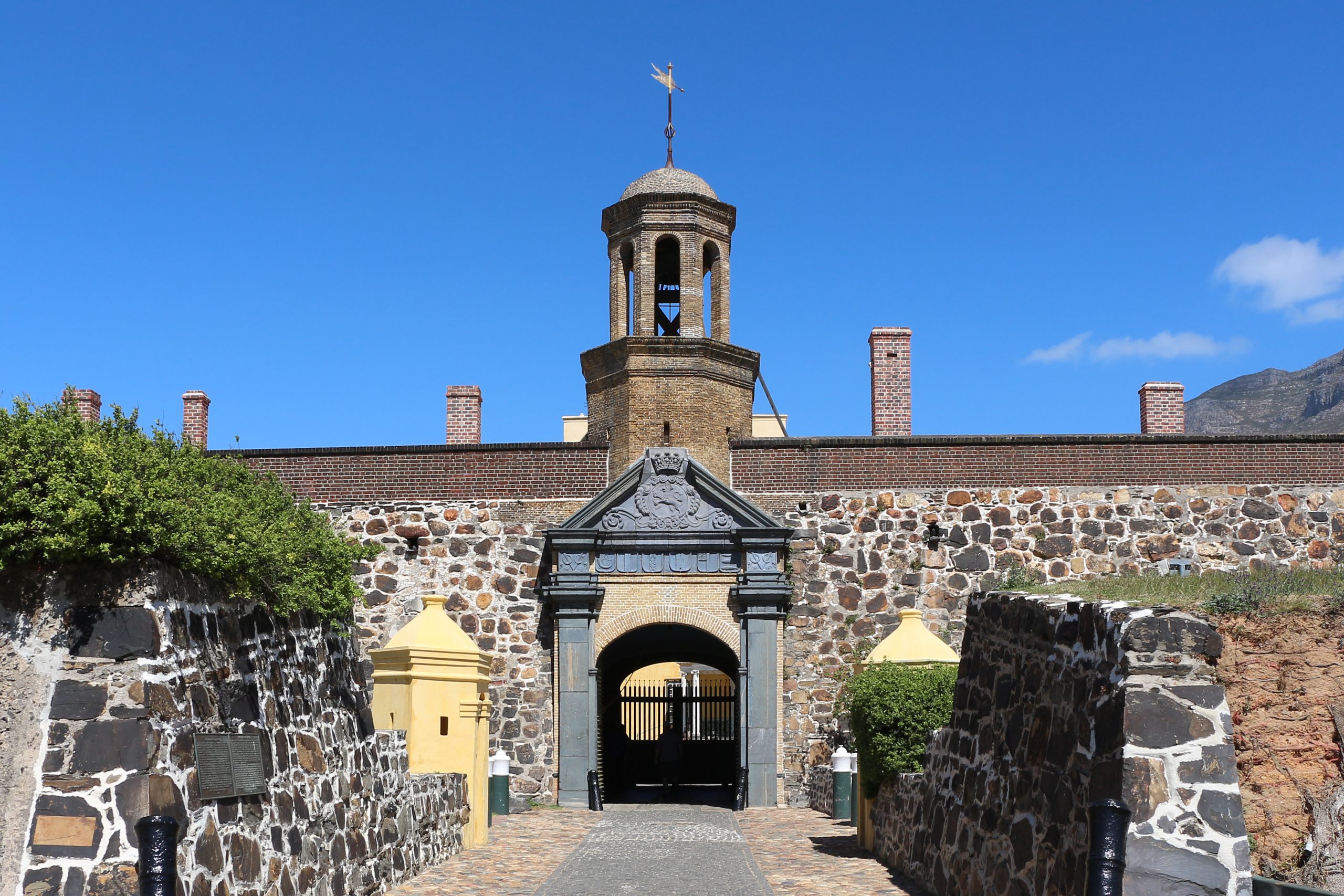
The Castle of Good Hope, at the bottom end of Darling Street, is the oldest surviving colonial building in South Africa: a pentagonal fort built by the Dutch East India Company between 1666 and 1679. It’s open daily from 09:00 to 16:00, with last ticket sales around 15:45 (check ahead), and runs guided tours at set times through the day. Adult entry sits around R50, with discounts for children, students and seniors; prices are revised from time to time, so check ahead before you go.
Across the road, the Grand Parade is where Nelson Mandela gave his first public speech after his release from prison in 1990, addressing crowds from the balcony of the Cape Town City Hall that overlooks the square.
- Cost: around R50 for adults (check ahead); the Grand Parade itself is free
- Hours: Castle 09:00-16:00 daily (check ahead for public holiday closures)
- Getting there: bottom of Darling Street, a short walk from Cape Town station
- Parking: metered street parking and paid lots nearby, attended during the day
District Six Museum: the Bowl’s hardest history
On Buitenkant Street, right on the edge of the City Bowl, the District Six Museum tells the story of the forced removals of the 1960s and 1970s, when apartheid authorities bulldozed a mixed-race inner-city neighbourhood and relocated its residents to the Cape Flats. It’s one of the most affecting stops in central Cape Town, built around oral histories, street signs rescued from the demolition, and a floor map that former residents have annotated by hand.
The museum is open Monday to Saturday, 09:00 to 16:00, with Sunday visits by appointment. A self-guided visit costs around R60, and a tour led by a former resident costs more (check current pricing and book ahead through the museum or Quicket).
- Cost: from around R60 self-guided (check ahead)
- Hours: Mon-Sat 09:00-16:00, Sunday by appointment
- Getting there: 25A Buitenkant Street, walkable from the Castle of Good Hope and Long Street
- Good to know: book ahead, especially for a tour led by a former resident
Getting around the City Bowl
You don’t need a car for any of this. The City Bowl is flat enough to walk end to end in under half an hour, and MyCiTi buses run through the CBD via the Civic Centre interchange, with connections out to the Atlantic Seaboard, the southern suburbs and Cape Town International Airport.
If you’re driving in, expect metered street parking and paid parkades around Long Street, Greenmarket Square and the Company’s Garden precinct; stick to attended, well-lit parking where possible. Greenmarket Square itself, a pedestrianised square just off Long Street, runs a street market Monday to Saturday selling African crafts, textiles and jewellery, where bargaining is normal but a fair price is appreciated.
Walking is safest by day on busy, well-lit streets. After dark, favour a short rideshare over walking between venues, particularly around Long Street and the station precinct. If you want to extend the day, the lower station of the Table Mountain Aerial Cableway is roughly a 15-minute drive (or a MyCiTi ride to Kloof Nek plus a steep uphill walk) from the city centre, and the V&A Waterfront is a similarly short hop for an afternoon by the harbour.
Visiting now, in October, works in your favour: see our guide to Cape Town’s cheapest month to visit for why the shoulder season means shorter queues at the Castle and the museums.
FAQ
Is the City Bowl safe to walk around?
Generally yes during the day, especially along the main tourist routes between Company’s Garden, Bo-Kaap and Long Street. Petty crime such as bag-snatching and pickpocketing is the main risk in crowded areas, so keep phones and valuables out of sight and use a rideshare rather than walking after dark.
How long do you need to see the City Bowl’s highlights?
A full day covers the main sights comfortably: Bo-Kaap and Company’s Garden in the morning, the Castle and District Six Museum in the afternoon, and Long Street in the evening. Two days gives you room to add the museums properly and a trip up Table Mountain.
Is Bo-Kaap okay to visit as a tourist?
Yes, but remember it’s a residential neighbourhood with a strong Muslim community, not a backdrop. Avoid photographing residents or their front doors without asking, and dress modestly if you visit a mosque.
Do you need a car to see the City Bowl?
No. It’s the most walkable part of Cape Town, and MyCiTi buses cover the CBD if you’re coming in from elsewhere. A car is more useful for onward trips to the Atlantic Seaboard or Table Mountain than for the Bowl itself.
Is the Castle of Good Hope worth the entry fee?
For most first-time visitors, yes: it’s the oldest building of its kind in the country, compact enough to see properly in an hour, and the guided tours add context that’s easy to miss walking through alone.
Sources & further reading
- The Traveller’s Guide to Bo-Kaap – Cape Town Tourism
- Auwal Mosque – Wikipedia
- District Six Museum official site
- Castle of Good Hope opening hours – WhichMuseum
- Greenmarket Square – Afar
- Company’s Garden Cape Town – South Africa Tourism
- City calls for input on proposed new MyCiTi stops – MyCiTi
- Getting Here – Table Mountain Aerial Cableway
Featured image: Castle of Good Hope, Cape Town 01 by Bernard Gagnon, via Openverse (wikimedia) — BY-SA 4.0