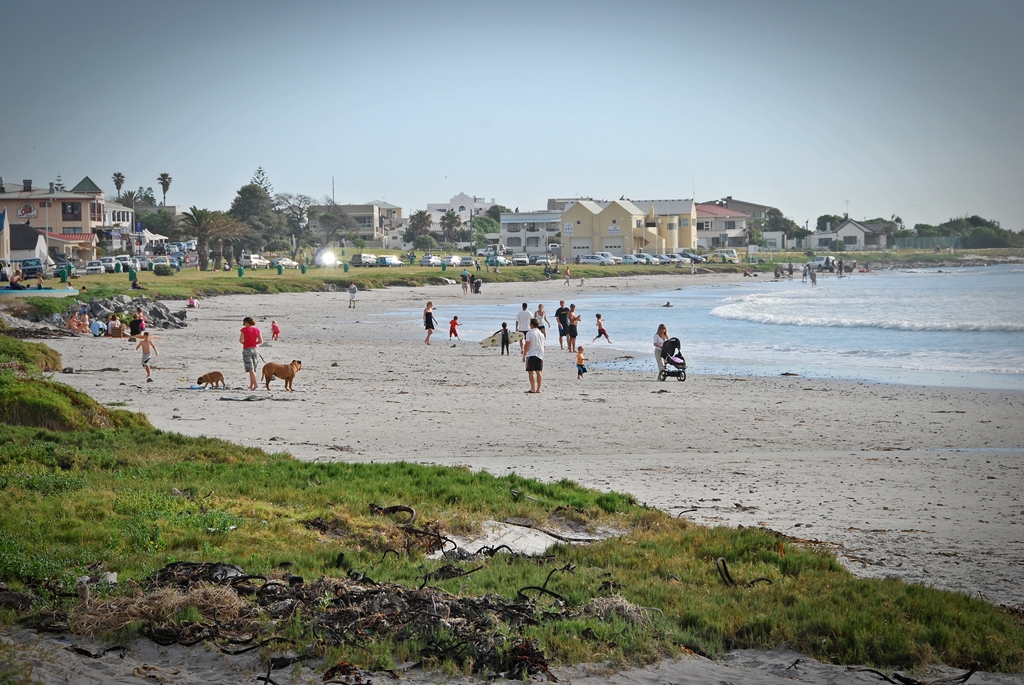
Fifteen minutes north of Blouberg, Otto du Plessis Drive runs out of suburbs. The houses thin, the strandveld takes over, and then the road drops towards a low white village wrapped around a rocky point. That’s Melkbosstrand, still part of Cape Town on paper, but a proper village in every way that counts. Locals shorten it to Melkbos and tend to go quiet when outsiders ask what it’s like, which tells you most of what you need to know.
Mid-June is an honest time to visit. The summer crowds are long gone, the snoek run is on, and somewhere out in the cold water the first southern right whales of the season are working their way up the coast. Between the winter fronts you get those still, rinsed-clean days when the light is sharper than anything summer produces. This guide walks the village south to north, the way you’d actually do it on foot.
Start at Melkbos Point: A Slipway, a Sea Rescue Base and a Cannon
Begin at the southern end of the village, where a rocky outcrop called Melkbos Point pushes into the Atlantic. This is the working end of Melkbos. The National Sea Rescue Institute’s Station 18 sits here, and on the northern edge of the Point there’s a slipway where ski-boats launch when the weather allows. On a good winter morning you’ll hear boat trailers rattling down before you see the sea.
The Point also carries the village’s history. British troops came ashore near here in January 1806, in the days before the Battle of Blaauwberg handed the Cape to Britain, and a cannon set on the foreshore commemorates the fight. Before that the bay was known as Losperd’s Bay. The current name comes from the melkbos itself, the milk bush that grows on the dunes and bleeds a white latex when you snap a stem. One more piece of trivia for the walk: several of the undersea communication cables linking South Africa to the rest of the world come ashore at Melkbosstrand, so a decent share of the country’s international traffic passes under this beach.
Stand on the rocks for a minute before moving on. The bay opens north in a long, pale curve, and behind you, across Table Bay, the whole Table Mountain range stacks up in winter blues. It’s the same postcard view Blouberg trades on, just with nobody standing in front of it.
Beach Road: Where the Village Eats
From the Point, walk north along Beach Road, the strip that runs parallel to the sand. This is Melkbos’s whole restaurant scene, and its compactness is the charm: you can read every menu in ten minutes of strolling. Café Orca is the seafood stalwart on the beachfront, the name locals give first when you ask where to eat fish. Die Damhuis is the family standby, also right on the front. I Love Melkies does the casual pizzas-and-burgers end of things with the beach across the road, and Melkbos Kitchen is the small spot people mention for sunsets. In winter it pays to phone ahead: evenings are quieter and some kitchens trim their hours between fronts, so check before making the drive for dinner. There’s also a monthly food fair in an old barn on a farm just off the R27, usually on the first Saturday of the month; confirm it’s on before building a morning around it.


What you’re smelling on this stretch, most June days, is the season itself. Snoek runs along this coast from autumn into July, and the West Coast tradition of langanas selling fresh fish off the back of a bakkie is alive and well from Cape Town northwards. If you see a queue forming next to a parked bakkie, join it and ask questions later.
The Main Beach and the Long Walk to the Koeberg Fence
Now get onto the sand. Melkbosstrand’s beach runs roughly 7 km, flat and white, and the bay behind Melkbos Point is unusually protected for this coast, so the waves arrive smaller and better behaved than at the beaches to the south. Surfers rate Melkbos for exactly that reason. It’s a forgiving, funboard-friendly stretch, popular with longboarders, and it’s often the fallback when the southern beaches are blown out. If it’s the full big-air kite circus you’re after, that remains Blouberg’s department; see our guide to watching the kitesurfers for where to stand. Melkbos is where you come when you don’t want a circus at all.

Walking north, the beach reads like a map of Afrikaans place names. First comes Slabbert se Klippe, a rocky outcrop where the fishermen gather with rods planted in the sand, which separates the main beach from Kapteinsbaai. Beyond that the houses of Van Riebeeckstrand face the water. Keep going and the buildings eventually stop altogether, and the domes of the Koeberg power station grow on the horizon. From Melkbos Point you can walk about 4 km up the beach before you reach the boundary of the Koeberg protected zone, and on a weekday in June you may well do the whole stretch alone, with kelp heaped on the tideline and white-fronted plovers running the wash. Turn around at the fence and Table Mountain is waiting for you, dead ahead, for the entire walk back.
Koeberg Nature Reserve: Two Trails on the Other Side of the Fence
The land around the power station is not off limits. Koeberg Nature Reserve, reached off the R27 between the Duynefontein and Atlantis turn-offs, protects a spread of West Coast strandveld and dune veld, and it’s one of the most underrated walks in greater Cape Town. Two marked trails leave from the visitor area. The Grysbok Trail is the gentle option, just under 6 km and around two hours, taking in a stretch of beach and passing a salt marsh that is at its birdiest in exactly this winter season. The Dikkop Trail is the commitment: a circular route that runs anywhere from about 9 km to over 20 km depending on the loop you choose, with a stretch on the beach.
Take binoculars if you own them. More than 150 bird species have been recorded here, ostrich and African fish eagle among them, and the buck you’re most likely to jump on the path are grysbok, steenbok and springbok. Pick a clear day between fronts, start mid-morning once the dew burns off, and take your ID along, as entry involves signing in at the gate. Confirm before you drive out that the reserve is open, because Eskom has suspended access at short notice before.
Mid-June Extras: Whales, Snoek and the Weather Window
June changes what Melkbos is for. The southern right whales that spend summer feeding in the Southern Ocean start arriving off the Western Cape in early June, and the season then runs deep into spring. Right now, in mid-June 2026, sightings are a bonus rather than a guarantee, but that’s part of the game: pick a bench above the beach or the rocks at the Point, scan the water beyond the backline, and give it twenty minutes. A blow hangs in cold winter air far longer than you’d expect.
The snoek run is the surer bet. The season peaks between May and July, so this is the month to eat it: braaied over coals in the West Coast style if you can find it done properly, or fresh off a bakkie to cook yourself. Ask at any of the Beach Road restaurants what came in this week.
And then there’s the weather itself. Winter here is not one long grey slab; it’s a rhythm of two or three wet, wild days followed by still, bright ones with no wind at all, which are frankly the best beach-walking days of the year. Golfers use the same windows on the Atlantic Beach links on the southern edge of the village, an 18-hole course laid out through the dunes with the mountain across the bay.
Making a Day of It
Melkbosstrand sits about 30 km from the Cape Town city centre, an easy run up the R27 or the slower, prettier coastal road through Bloubergstrand and Big Bay. Plenty of people fold it into a bigger West Coast day, and it pairs naturally with the beaches to its south: do the sunrise-to-sundowner Blouberg day once, then come back and give Melkbos its own unhurried outing. If the budget is tight, almost everything in this guide costs nothing anyway; the same instinct behind the free things locals actually do in Blouberg applies here, just with fewer people around to share it.
One last piece of advice, offered in the spirit of the village. When you get home and someone asks how Melkbos was, consider saying it was fine, a bit quiet, nothing special. The locals have been running that line for years. It’s working.
Sources & further reading
- Melkbosstrand Beach – Cape Town Beaches
- Melkbosstrand – West Coast Way
- Melkbosstrand – Wikipedia
- Things To Do in Melkbosstrand – SA-Venues
- Melkbosstrand: from battlefield to water sports playground – South African Tourism
- Hiking in Koeberg Nature Reserve – SA-Venues
- Getting to know Snoek – Masifundise
- The Battle of Blaauwberg, 200 years ago – SA Military History Society
Featured image: Beach at Melkbosstrand.JPG by Ossewa, via Wikimedia Commons (taken on location) — CC BY-SA 3.0