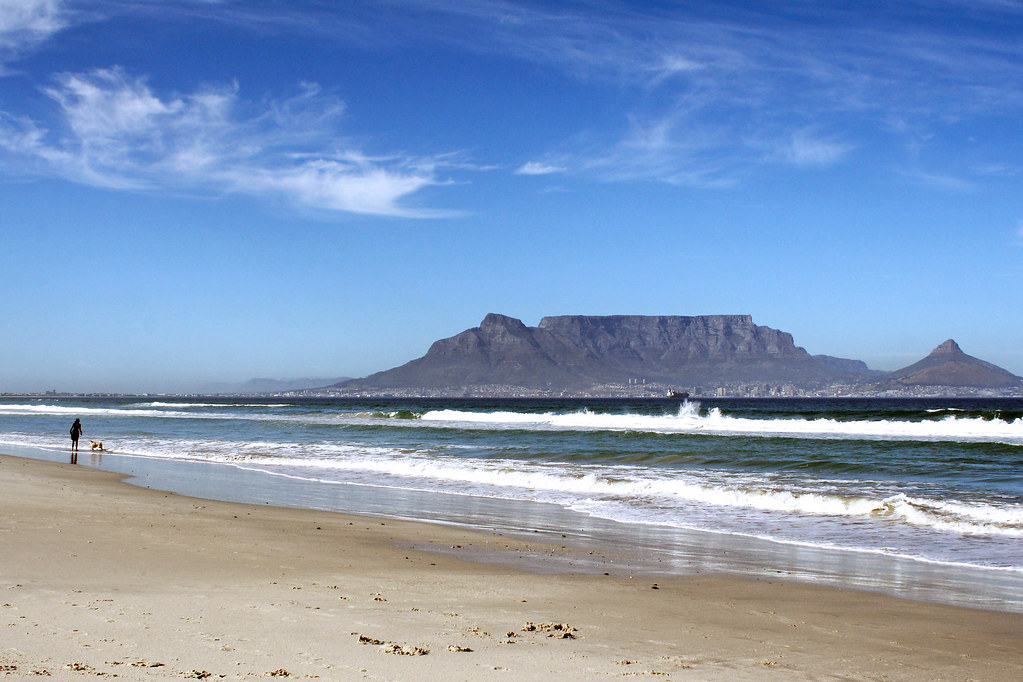
The best things to do in Bloubergstrand are simple and world-class: walk the beaches with that famous head-on view of Table Mountain, watch (or learn) kitesurfing on one of the windiest stretches of coast on earth, and end the day with sundowners at a beachfront restaurant in the old village. Bloubergstrand sits about 15 km north of Cape Town’s city centre on the shore of Table Bay, and together with Table View, Big Bay, Sunset Beach and Melkbosstrand it makes up Cape Town’s West Coast beachfront strip. This guide covers every beach and precinct, with the practical details that most guides leave out: parking, costs, wind exposure.
Blouberg, Table View or Big Bay — what’s the difference?
Locals use “Blouberg” loosely for the whole coastal strip, but each name is a specific place. Bloubergstrand is the original seaside village around Stadler Road and Small Bay; the name is Afrikaans for “blue mountain beach”, after the 231 m Blaauwberg Hill behind it (not to be confused with Blouberg in Limpopo; this is firmly Cape Town). Big Bay is the modern beach node just north of the village, anchored by the Eden on the Bay centre. Table View is the larger suburb inland and south of the village, with its own beachfront along Marine Drive that includes the famous Kite Beach. Sunset Beach and Melkbosstrand bracket the strip to the south and north respectively.
The area has real history too: the Battle of Blaauwberg was fought here in 1806, when British forces landed and defeated the Dutch-Batavian defenders, the fight that put the Cape under British control. Robben Island sits about 7 km offshore and is visible from every beach on this list.
Which Blouberg beach should you choose?
Short answer: Big Bay for families and swimming, Kite Beach for wind sports and watching kitesurfers, Small Bay for photographs and restaurants, Sunset Beach for quiet walks, and Melkbosstrand for a Blue Flag beach day. Here they are from south to north.
Sunset Beach and Dolphin Beach
Sunset Beach is the quietest stretch, a long band of white sand between Milnerton Lagoon and Table View backed by a residential suburb. The south-easter tends to arrive here first, which makes it popular with windsurfers and experienced kitesurfers, and the Table Mountain view is as good as anywhere on the strip. Dolphin Beach, at the landmark hotel of the same name on Marine Drive, is the next node up and a busy kite-launching spot in season.
- Cost: Free.
- Parking: Street parking on the residential roads; a gravel parking area at Dolphin Beach. Don’t leave valuables visible.
- Wind exposure: Very high; first to feel the south-easter. Best before about 11:00 in summer.
- Swimming: Open water with no lifeguards, so paddling rather than swimming.
- Kids and dogs: Great for dog walks on the long open stretch; keep dogs on a lead near other beach users and follow posted signage.
Kite Beach and the Table View beachfront
Kite Beach, roughly halfway between Dolphin Beach and the Table View beachfront proper, is the epicentre of Cape Town kitesurfing. On a windy summer afternoon there can be more than a hundred kites in the air, and the Red Bull King of the Air (the sport’s most famous big-air contest) has been staged on this stretch of coast during a wind window in late spring and early summer. Even if you never touch a kite, the spectacle from the beach around sunset is one of the best free shows in Cape Town.
- Cost: Free to watch; kite lessons vary by school and package, so check ahead with operators along Marine Drive.
- Parking: Gravel and street parking off Marine Drive and Otto du Plessis Drive; arrive before mid-afternoon on windy weekend days.
- Getting there: MyCiTi T01 trunk bus from the Civic Centre to Table View station, then a short walk down Blaauwberg Road to the beachfront.
- Wind exposure: Maximum — that’s the point. October to March is kite season; December to February is peak.
- Swimming: Not a swimming beach: kites, boards and chop.
Small Bay (Bloubergstrand village)
Small Bay is the sheltered curve of sand and granite boulders in front of the old village, and it’s where the classic postcard photo of Table Mountain across the bay is taken. The rocks give it some protection from the summer south-easter, tidal rock pools appear at low tide, and the village’s best restaurants sit directly behind the sand. It’s the most photogenic and the most “local” of the beaches.
- Cost: Free.
- Parking: Street parking on Stadler Road and around the village; it fills fast at sunset in summer.
- Wind exposure: Moderate. More sheltered than Kite Beach, but still breezy on a strong south-easter day.
- Swimming: Calm-day paddling and rock pools; no lifeguards.
- Kids and dogs: Good for kids at low tide (rock pools); dogs common on early-morning walks.
Big Bay
Big Bay is the strip’s family headquarters: a wide, gently shelving beach with a landscaped promenade, grass terraces, and the Eden on the Bay restaurant-and-shops centre behind it. It’s the main learn-to-surf beach on this coast, a beginner-friendly kite spot on moderate days, and home to the Big Bay Surf Lifesaving Club, whose volunteer lifeguards patrol over the summer season, typically from early November until after Easter, on Saturday afternoons and through the day on Sundays and peak holidays.
- Cost: Free; surf lessons (board and wetsuit included, roughly 90 minutes) are offered year-round by schools based at the beach; check ahead for current rates.
- Parking: The best on the strip: large public parking areas at the beach plus basement parking at Eden on the Bay.
- Getting there: MyCiTi 214 feeder bus (Big Bay – Table View – Parklands) stops at Eden on the Bay.
- Wind exposure: High in summer afternoons; mornings are usually calmer and better for swimming and surf lessons.
- Kids and dogs: The most kid-friendly beach here: lawns, a promenade, ice cream within pram distance. Busy sections are better without dogs in peak season.
Eerste Steen and the Blaauwberg coast
North of Big Bay the houses stop and the coast turns wild. Eerste Steen, inside the Blaauwberg Nature Reserve about 3 km up Otto du Plessis Drive, is a managed picnic site with braai spots behind the dunes and a long, empty beach in front, the closest thing to a West Coast wilderness beach within the city. There’s a small conservation entry fee per vehicle and per person (budget a few rand per head plus a car fee; check the City of Cape Town’s current tariffs), and the gates close in the late afternoon, earlier in winter than in summer.
- Cost: Small entry fee (as of 2026 expect under R100 for a family with a car; check ahead).
- Hours: Daylight only, roughly 08:00 to 17:00 in winter and 08:00 to 19:00 in summer.
- Parking: Fenced parking area inside the reserve.
- Wind exposure: Fully exposed; magic on still mornings and winter days.
- Swimming: No: strong, cold open water. This is a walking, braai and whale-spotting (in season) beach.
Melkbosstrand
Melkbosstrand, about 15 minutes’ drive north of Big Bay, is a proper small beach town with soft white sand and a gentler feel than the Blouberg strip. Its main beach holds Blue Flag status for the 2025/26 season, one of only eight in Cape Town, which means monitored water quality, facilities and seasonal lifeguards during the Blue Flag season (1 December to 28 February). The beachfront restaurant row, with tables practically on the sand, is a destination in its own right.
- Cost: Free.
- Parking: Public parking areas and street parking along the beachfront.
- Wind exposure: Exposed to the south-easter but often slightly gentler than Table View; superb on winter mornings.
- Swimming: The best on this coast during the Blue Flag season, though still Atlantic-cold.
- Kids and dogs: Very family-friendly; long dog-walking stretches away from the main swimming area.
What are the best things to do in Blouberg besides the beach?
Learn to kitesurf — or just watch the pros
This coast is one of the world’s premier kitesurfing destinations, powered by the “Cape Doctor” south-easter that blows reliably from October to March, with December to February delivering rideable wind on well over half of all days. Several schools operate between Sunset Beach and Big Bay offering beginner courses with all gear included; conditions here are waves-and-chop rather than flat water, so complete beginners sometimes start with a lesson block or a day trip to Langebaan’s lagoon. The water demands a 4/3 wetsuit even in summer. Before you book a session (or drive out to watch), check the live Bloubergstrand weather station for real-time wind speed and direction.
Take a surf lesson at Big Bay
Big Bay’s gradual sandbank makes it one of Cape Town’s most forgiving learn-to-surf spots, and schools based at the beach run group and private lessons year-round, generally taking kids from about age five. Mornings are best, before the wind comes up. Wetsuits are non-negotiable: the Benguela Current keeps the sea between roughly 12 °C and 17 °C all year.
Hike the dunes at Blaauwberg Nature Reserve
The reserve behind Eerste Steen protects a rare stretch of coastal fynbos and dunes, with a circular Coastal Dune Trail of about 4.4 km starting from the Eerstesteen site. On the inland side, Blaauwberg Hill, site of the 1806 battle, offers guided access and sweeping views over Table Bay to the mountain. It’s an easy, flattish walk; take water and sun protection, as there’s almost no shade.
Go birding or paddling at Rietvlei
The Table Bay Nature Reserve’s Rietvlei section, just inland of Table View, is a 663-hectare wetland, the heart of the 880-hectare Table Bay Nature Reserve, where more than 200 bird species have been recorded, including seasonal flocks of flamingos and pelicans, viewable from two bird hides. A separate designated water-sports area hosts sailing, paddling and canoeing. The reserve keeps daytime hours (entry roughly 07:30–16:00; all visitors out by 17:00), so plan a morning visit.
Get the postcard photo of Table Mountain
The definitive Table Mountain photograph (mountain, city and Robben Island across the water) is taken from the rocks at Small Bay and along the shoreline off Stadler Road and Sir David Baird Drive. Golden hour before sunset lights the mountain; sunrise gives you glassy water and empty sand. In winter, passing cold fronts deliver dramatic cloud and the clearest air of the year.
Where should you eat and drink in Blouberg?
The strip has three distinct eating precincts. In Bloubergstrand village, the beachfront cluster around Stadler Road includes Ons Huisie — a restored 19th-century fisherman’s cottage turned restaurant, typically open daily from morning until evening (check ahead) — and On The Rocks, a long-standing special-occasion spot with waves breaking below the windows. The Blue Peter’s lawn is the area’s institution for sundowners with fish and chips.
At Big Bay, Eden on the Bay offers the widest choice: a beachfront centre of restaurants, coffee shops and takeaway counters where you can eat with your feet steps from the promenade. In Melkbosstrand, the beachfront row spans seafood institutions and Portuguese-style kitchens, most with front-row sunset seats. Booking ahead is wise anywhere on the strip on summer weekend evenings.
How do you get to Bloubergstrand — and around?
By car, take the R27 (West Coast Road) or Marine Drive north from the city; it’s about 15 km to Bloubergstrand and roughly 25–40 minutes depending on traffic. Allow more in weekday peaks, when the R27 is one of Cape Town’s busiest corridors. Melkbosstrand is about 30 km from town.
By public transport, the MyCiTi bus is genuinely usable here: the T01 trunk route runs from the Civic Centre in town along the R27 to Table View station on Blaauwberg Road, and the 214 feeder continues to Big Bay, with the 213 serving West Beach. From Cape Town International Airport, take the A01 airport shuttle to the Civic Centre and transfer to the T01; you’ll need a myconnect card, sold at stations. E-hailing (Uber/Bolt) works well across the whole strip.
When is the best time to visit Blouberg?
It depends what you’re here for. Summer (November–March) is kite season: hot days, big wind from early afternoon, electric atmosphere at Kite Beach and Big Bay. Do your swimming and walking before about 11:00. Autumn (April–May) and spring (September–October) bring the best balance of mild weather and lighter wind. Winter (June–August) is the locals’ secret: between cold fronts you get windless, crystal-clear days, empty beaches and the best photography light of the year. Whatever the season, conditions change fast on this coast, so check the current wind before you commit to the drive.
FAQ
Is Bloubergstrand safe?
The beachfront nodes (Small Bay, Big Bay, Eden on the Bay and the Table View promenade) are busy and well-used, and the usual Cape Town common sense applies: don’t leave anything visible in a parked car, keep phones and cameras close on quiet stretches, and avoid isolated beach sections alone after dark. Swimming safety is the bigger everyday risk (see below).
Can you swim at Blouberg Beach?
Yes, but selectively. The Atlantic here is cold year-round (roughly 12–17 °C) and the open beaches have currents and wind chop, so swim at Big Bay when lifeguards are on duty in season, or at Melkbosstrand during the Blue Flag season (1 December – 28 February). Small Bay’s rock pools suit small children at low tide. Most locals treat the sea as a plunge-and-out affair rather than a long swim.
How far is Bloubergstrand from Cape Town?
About 15 km north of the city centre, typically 25 to 40 minutes by car via the R27 or Marine Drive, longer in weekday rush hour. The MyCiTi T01 bus covers the route from the Civic Centre to Table View, with the 214 feeder continuing to Big Bay.
Is Bloubergstrand worth visiting?
Absolutely. It offers the single most famous view of Table Mountain, world-class kitesurfing spectacle from October to March, some of Cape Town’s most family-friendly beach infrastructure at Big Bay, and beachfront dining at village prices rather than Camps Bay prices. It’s an easy half-day from the city and a superb base for a longer stay.
Where is the famous Table Mountain photo taken?
From the beach and boulders at Small Bay in Bloubergstrand village, near Stadler Road. Arrive an hour before sunset for golden light on the mountain, or at sunrise for still water and empty sand. Check the wind first, because a strong south-easter means sandblasting rather than photography.
Sources & further reading
- Wikipedia — Bloubergstrand
- Wakeup Stoked — Kitesurf Cape Town: Spot Guide
- EWN — Blue Flag status awarded to 8 Cape Town beaches for 2025/26 season
- MyCiTi — New routes open in Table View area
- Cape Town Tourism — A whole new world awaits at Table Bay Nature Reserve
- Ons Huisie — Location
- Seatemperature.net — Bloubergstrand water temperature
- Ostrich Trails — Blaauwberg Nature Reserve walk
Featured image: Cape Town at a glance by Dimitry B, via Openverse (flickr) — BY 2.0