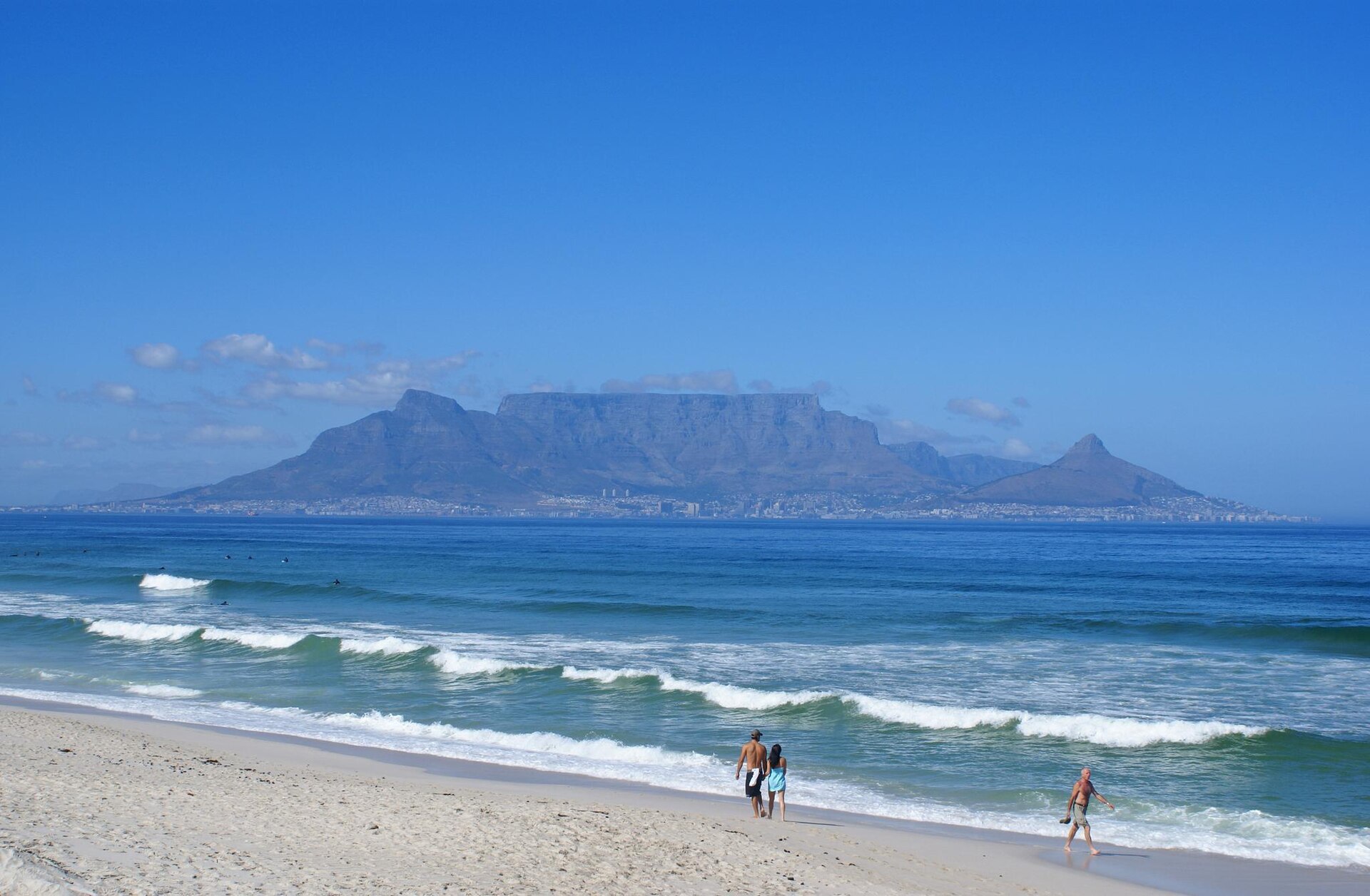
Something quietly pleasant happens to the sea at Blouberg around this time of year. It is late May, the southeaster has packed up for the winter, and the water off Big Bay and Small Bay has settled into a steady, almost civilised 14°C or so. That will sound like faint praise until you remember what January can do: a 35-degree beach day, sand too hot to stand on, and water that reads 11°C and grabs the air out of your lungs.
That is the part visitors never believe. On Cape Town’s West Coast, the hottest weeks of summer regularly produce the coldest sea of the year, and a mild autumn morning like this one can offer a kinder swim than Christmas Day. The reason is a single mechanism, and once you have seen it, you can read the water temperature off the wind forecast before you have packed a towel.
The wind controls the water, not the calendar
The Atlantic off Bloubergstrand is the inshore edge of the Benguela system, one of the world’s great eastern-boundary upwelling zones. The surface layer of any ocean is the warm bit, heated by the sun and only a few tens of metres deep. Below it sits water that has not seen sunlight in a long time, and off this coast that deep water is genuinely cold, drawn up from a couple of hundred metres down.
When the southeaster blows hard along this stretch of coast, it drags the warm surface layer with it. Because the Earth rotates, moving surface water in the southern hemisphere gets deflected to the left of the wind, which here means offshore. The warm top layer is skimmed away to sea, and the only thing available to replace it is that cold, deep, nutrient-rich water from below. Oceanographers call it Ekman transport; swimmers call it something less printable. A couple of days of pumping southeaster can strip several degrees off the inshore temperature.
The same process is why this coast is so alive. The upwelled water carries nutrients that feed plankton blooms, which feed the fish, the seals, the seabirds and the kelp. The cold is not a flaw in the system. It is the system.
Summer is upwelling season, which is why January bites
Here is the counterintuitive core of it. The southeaster is a spring and summer wind, driven by the South Atlantic high-pressure cell that parks itself offshore from roughly September to March. That is precisely why Blouberg is a world kitesurfing destination in those months, a pattern we have unpacked in detail in our guide to when Cape Town’s wind season starts and ends. But the same wind that fills ten thousand kites is the wind that drives the upwelling.
So the machinery runs hardest exactly when the beach is at its busiest. Research on the southern Benguela consistently shows upwelling peaking through austral spring and summer, with Table Bay sitting between two of the system’s most active cells, off the Cape Peninsula to the south and Cape Columbine to the north. A February heatwave in Blouberg usually means days of strong southeaster, and days of strong southeaster mean the sea is being actively refrigerated while the land bakes.
Flip the logic and you get autumn. By May the high-pressure cell has drifted away, the southeaster loses its grip, and the upwelling engine idles. The surface layer stops being skimmed offshore, and the sea settles into its mildest, most predictable stretch of the year. It is never warm here in any tropical sense, but a calm 14-15°C in April or May with no wind chill is a far friendlier proposition than a churned-up 11°C in December.
The monthly numbers, and why the average lies to you
Long-run satellite records for Bloubergstrand tell a strange story: the monthly averages barely move. One ten-year record puts February, the warmest month, at about 15.6°C and the coolest month under 14°C, a seasonal swing of less than two degrees. The annual average sits near 14.7°C. Different datasets disagree, sometimes by two or three degrees, depending on how far offshore they sample, so treat every figure below as a band rather than a promise.
| Month | Typical average | What the day can actually serve up |
|---|---|---|
| January | 15-16°C | Wildly variable; strong upwelling can drop it to 11-12°C |
| February | 15-16°C | Warmest on average, still hostage to the southeaster |
| March | 15°C | Wind easing; warm spells become more common |
| April | 14°C | Steady and calm; often the pleasantest swimming window |
| May | 14°C | Mild and stable as upwelling season ends |
| June | 14°C | Stable; cold fronts bring swell rather than cold water |
| July | 14-14.5°C | Little day-to-day movement |
| August | 14°C | Air is cold, water is unremarkable |
| September | 14-15°C | First southeasters return; volatility creeps back |
| October | 14.5-15°C | Upwelling season building |
| November | 15°C | Big swings either way as the wind machine spins up |
| December | 15°C | Widest recorded spread of the year, from about 11°C into the high teens |
Read that third column, not the second. The gap between a good day and a bad day in summer is bigger than the gap between summer and winter. Logged readings for December at Bloubergstrand have ranged from roughly 11°C into the high teens across different years and wind conditions. The calendar tells you almost nothing; the last three days of wind tell you nearly everything.
Warm-water days exist, and you can see them coming
Every summer produces a handful of days when the Blouberg sea turns implausibly mild, sometimes climbing into the high teens. The recipe is consistent. The southeaster dies, and stays dead for two or three days. With nothing skimming it away, the sun-warmed surface layer drifts back inshore, sometimes helped along by a light northwesterly. Marine scientists at UCT have studied these warm events in the Cape Peninsula upwelling cell as a phenomenon in their own right, so this is not beach folklore; it is documented ocean behaviour.
If you want to catch one, watch the forecast for a multi-day wind gap in late summer or early autumn, February to April, when there is plenty of warmed surface water offshore waiting to slide back in. The morning after a windless hot spell is your best odds of a genuinely comfortable Atlantic swim. And if you need reliably warmer water rather than lucky days, that is what False Bay is for: the Muizenberg side of the mountain runs several degrees warmer through summer because it faces away from the upwelling engine.
The wetsuit maths is simple
Surf forecasting guides for Big Bay and Bloubergstrand converge on roughly the same advice, which maps onto temperature like this:
| Water temperature | What most people wear |
|---|---|
| 16°C and up | Spring suit or 3/2mm full suit; hardy swimmers manage short dips in costume |
| 14-16°C | 3/2mm full suit; boots optional for long sessions |
| 12-14°C | 4/3mm full suit with booties |
| Below 12°C | 4/3mm or 5/4mm with booties, and a hood and gloves if you feel the cold |
Kiters generate their own heat working the bar and mostly get away with a 3/2mm through summer, though on a hard upwelling day the ones staying out longest are in thicker rubber; our kite spot wind guide covers which launches work in which wind. Learner surfers should not let any of this put them off: the surf schools at Big Bay supply proper suits, and as we noted in our beginner’s guide to surfing Big Bay, a well-fitted 4/3 makes a winter session entirely comfortable. The people you see suffering are the ones who trusted a hot air forecast and packed a shorty in December.
Questions people keep asking
Can you swim at Blouberg without a wetsuit?
Briefly, yes, and plenty of locals do a short plunge year-round. But 12-14°C water triggers cold-water shock in the unacclimatised: involuntary gasping and a racing heart rate in the first minute. Wade in gradually, keep first dips short, and never jump straight into deep water on a cold day.
Which month has the warmest sea?
February holds the highest long-run average, at around 15.6°C in one ten-year satellite record. But March and April often deliver the most pleasant actual swims, because the wind fades and the temperature stops crashing every few days.
Why is Muizenberg so much warmer than Blouberg?
False Bay is broad, comparatively shallow, and sheltered from the direct upwelling that the open Atlantic coast takes head-on, so its surface water holds summer warmth instead of being stripped away. Same city, same season, different ocean behaviour.
Is the sea colder in winter?
Barely. Winter averages sit around 14°C, within a degree of most of the year. What winter removes is the volatility: no southeaster means no sudden upwelling crashes, so the water in June is more predictable than in December, and sometimes warmer than a bad day in high summer.
So before you decide whether the sea is swimmable this week, do not look at the month. Look at what the wind did over the last three days, as of this mild, windless May, that is the only forecast that counts.
Sources & further reading
- Bloubergstrand Sea Temperature by Month (10-year record) – SeaTemperatures.net
- Bloubergstrand Water Temperature – World Beach Guide
- Bloubergstrand Water Temperature and Wetsuit Guide – Surf-Forecast
- Cold Water Upwellings Explained – SouthAfrica.co.za
- A novel approach to quantify metrics of upwelling intensity, frequency, and duration (southern Benguela) – PLOS One
- Marine heatwaves and warm events in the Cape Peninsula upwelling cell, Southern Benguela – University of Cape Town
- When are the best diving conditions in Cape Town? – Kelptown
Featured image: Table Mountain DanieVDM.jpg by Danie van der Merwe from Cape Town, South Africa, via Wikimedia Commons (taken on location) — CC BY 2.0
