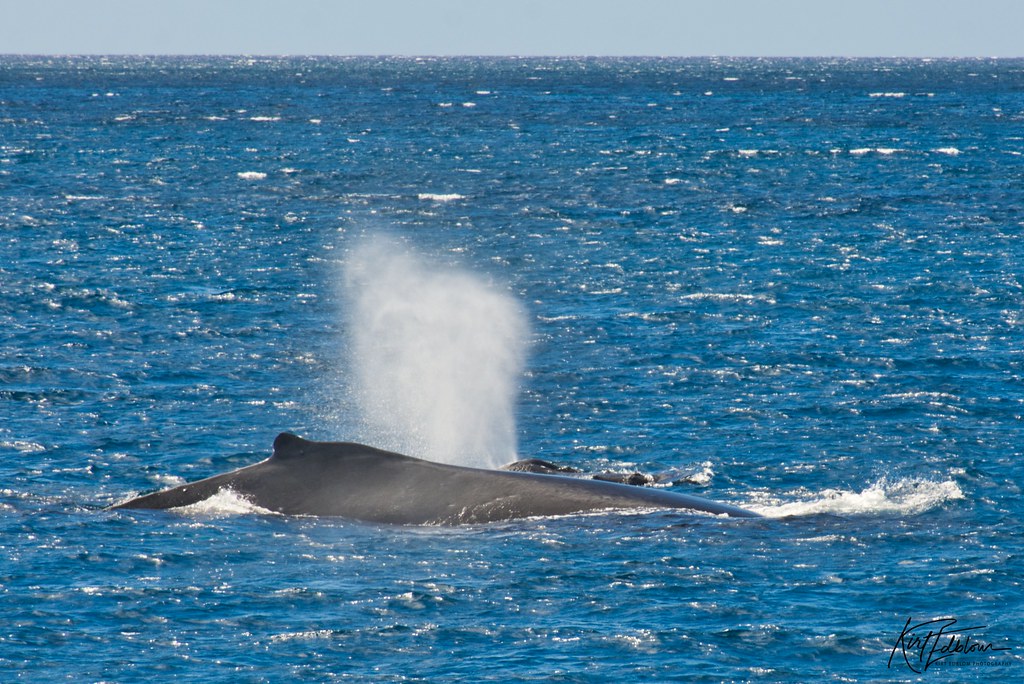
The first thing to know about a whale blow is that it hangs. A whitecap flares and is gone inside a second, ripped apart by the same wind that made it. A southern right’s blow climbs: a pale puff of spray that stands off the water for a beat, drifts, and thins out. Then, a little while later, it happens again in exactly the same patch of sea. On a still September morning you can pick one up from the Bloubergstrand beachfront with the naked eye at a kilometre or more, usually because something at the edge of your vision kept repeating itself until you stopped walking and stared.
So, the short answer to the question that brings most people to this page: yes, you can see whales from Bloubergstrand. From June to November, southern right whales move along the Cape’s coastline to mate and calve, and Table Bay gets its share. Drone clips of mother-and-calf pairs off Blouberg (Table Mountain sitting behind them like a stage set) do the rounds on Cape Town social media whenever a pair lingers close in. Early September, mid-season and building towards the spring peak, is precisely the time to start keeping half an eye on the water.
What you’re actually looking for
The whale you’re most likely to see from this coast is the southern right: a big, dark, unhurried animal that carries no dorsal fin at all. That absence is the single most useful field mark from shore. A broad back rolling through the surface with nothing breaking its line is a right whale; humpbacks and Bryde’s whales, which also move through Cape Town waters, both show a distinct fin as they roll.
The blow is the other giveaway. Right whales breathe through two well-separated blowholes, so the spout rises as a V — two diverging jets that can reach around five metres. Seen side-on it reads as one wide, dense puff, whiter and more vertical than anything the wind throws up. Get binoculars on a close animal and you may make out the pale, roughened patches on its head. Those are callosities, and their pattern is unique to each whale, the way fingerprints are to us.
You will see other things while you wait. Heaviside’s dolphins are regulars in the bay: small, quick, and found only along this cold-water coast. Cape fur seals loaf beyond the backline all year. A seal holding a flipper up to warm itself in the sun has fooled many a hopeful spotter. So has a raft of kelp. That’s part of the game.
The honest Hermanus comparison
Hermanus earns its reputation. Walker Bay is sheltered and shallow, a genuine nursery where hundreds of southern rights congregate between June and December, and the town’s cliff paths put you well above whales that sometimes drift within metres of the rocks. Its Whale Festival lands at the turn of September into October (2 to 4 October this year) for a reason: this is the peak. If seeing a whale is the entire point of your day, make the roughly two-hour drive around the mountain and go to the source. On numbers alone, Blouberg cannot compete and it would be dishonest to pretend otherwise.
Blouberg is a different proposition. Table Bay is a corridor and an occasional stopover rather than a nursery, and the beachfront path sits barely above sea level, which shortens your horizon and hides anything on the far side of a swell line. Sightings here are events, not a schedule: one week delivers a cow and calf metres beyond the kelp, the next three weeks deliver nothing. What Blouberg offers instead is the incidental whale. You came for a walk, a coffee at Big Bay or the postcard photo, and a blow goes up behind the surfers with Table Mountain as the backdrop. Nobody who has had that happen calls it second prize.
Where to stand
Anywhere along the strip between Small Bay and Big Bay works. The walkway above the beach gives you a long, uninterrupted arc of Atlantic, and an easy stroll covers a couple of kilometres of coastline. The more sea you can sweep in one slow gaze, the better your odds. If you’re new to the area, our Blouberg and Table View area guide covers the beachfront strip in detail.
Melkbosstrand, fifteen-odd minutes up the R27, is the quiet overachiever. It sits on the standard lists of West Coast whale-spotting places, and September, when southern rights pass in numbers, is its month. The long curve of beach faces more open water than Blouberg does, and if you’re driving up the West Coast for the spring wildflowers anyway, the two seasons overlap neatly: flowers inland, whales offshore, same tank of petrol.
Conditions decide everything
More than the month, more than the spot, the state of the sea decides whether you see anything. A 25-knot blow covers Table Bay in whitecaps and a whale’s spout vanishes among ten thousand pieces of identical white spray. What you want is light wind, a smooth or gently textured sea, and the sun behind you, which on this west-facing coast means morning, before the glare swings out over the water. September sits in the seam between winter’s northwesterly fronts and the summer southeaster; the Cape Doctor only settles into its relentless summer rhythm later in the year, so calm windows are still common. Check the live wind and sea conditions from our beachfront weather station before you commit to a session; if it’s already gusting over 20 knots, save your eyes for another day.
Once you’re there, technique matters more than luck:
- Scan a band, not the ocean. Most shore sightings happen between a few hundred metres and a couple of kilometres out. Sweep that strip slowly rather than staring at the horizon.
- Wait for the repeat. A surfacing whale blows several times before diving. One white flash means nothing; the same flash twice in the same place means stop and watch.
- Apply the fin test. Smooth rolling back with no fin: southern right. Back with a clear fin: humpback or Bryde’s — or, if it’s small and busy, a dolphin.
- Bring binoculars, not just a phone. Even a modest pair turns a distant smudge into an obvious animal. Phone cameras flatter nobody at a kilometre.
- Give it twenty minutes. Whales spend most of their time underwater or idling low in the water. A two-minute glance proves nothing either way.
- Go early. Mornings offer the best combination of low wind, soft light and an uncrowded walkway.
Quick answers
Can you see whales from Bloubergstrand without binoculars?
Yes, when conditions co-operate. A blow or a breach within a kilometre is obvious to the naked eye on a calm day, and southern rights do come that close inshore. Binoculars turn a maybe into a certainty, though, and they rescue the marginal days when the animal is further out or the sea is textured.
Are there whale-watching boats from Blouberg?
No. Boat-based whale watching in South Africa is tightly permit-controlled, and the dedicated operators run from Hermanus, Gansbaai and the False Bay side; the closest thing on this side of the mountain is a general marine wildlife cruise out of the V&A Waterfront, not anything launching off Blouberg’s beaches. From Blouberg the whale watching is free, shore-based and weather-dependent — which, in a September like this one, is most of its charm.
Sources & further reading
- Watch: Whale and her calf glide through Bloubergstrand waters — Cape Town Etc
- Whale Watching Cape Town — Oceans Africa
- Whale Watching on the Cape West Coast — SA-Venues
- Southern right whale — Whale & Dolphin Conservation
- South Africa country profile — IWC Whale Watching Handbook
- Southern Right Whales — Whale Watching in Walker Bay — Grootbos
- Whale Watching in Cape Town: All You Need to Know — Cape Town Tourism
- Hermanus Whale Festival — official site (2026 dates)
Featured image: Momma and baby by Kirt Edblom, via Openverse (flickr) — BY-SA 2.0